

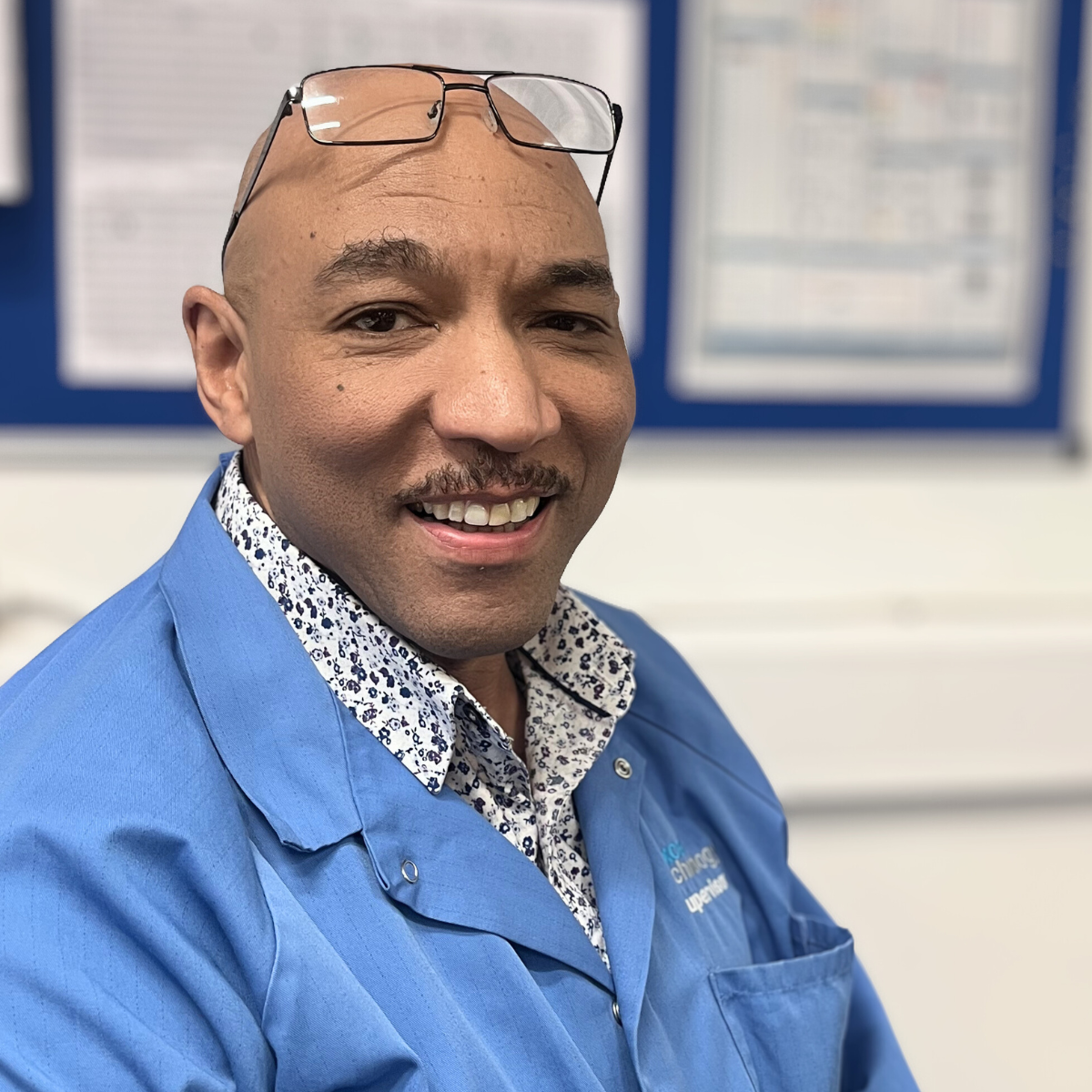
After almost 39 years at Texcel, Test Supervisor Willard Fennell is preparing to retire at Easter. We sat down with him at his test desk to hear the story of a career built on curiosity, calm and an unshakeable talent for finding the fault.
The Detective in the Test Lab
There is a particular quality to the atmosphere around Willard Fennell. When I arrive at the test department to meet him, he is deep in conversation with a colleague who has come to him for advice. He spots me across the room, breaks into a wide, warm smile and raises a hand in greeting without breaking the other person’s flow. He finishes the conversation thoroughly, unhurriedly, in the way that makes clear the other person has his full attention until they are done.
He is unphased. Unpressured. In a working environment where everything is go, go, go, sitting in his orbit feels like watching chaos arrive at a black hole of absolute calm. The work still gets done. Nothing is missed.
This is Willard Fennell: Test Supervisor at Texcel, almost 39 years in the making. He is retiring at Easter and while his colleagues are quietly dreading it, he is, it has to be said, absolutely delighted.
A Shed in Greenwich, a Staff of Thirty and a Love of Science Fiction
Willard joined Texcel on 13th April 1987. He was in his mid-twenties, a young man with a background in electronics study and a head full of science fiction, waiting for his first proper role in the industry. It was, he says, that love of science fiction that originally drew him towards electronics at all. The genre spoke to possibility, to invention, to the idea that technology is not just a product but a direction of travel.
Before Texcel, he had been working in banking, handling foreign exchange. It was a competent life but not the right one and when the opportunity came to interview for a role on the Inspection Team at a company called Texcel, he took it. The interview was with the QA managers and the offer followed shortly afterwards. That April he turned up for his first day at the company’s original site in Greenwich.
He laughs when he describes the building. A large industrial shed, he calls it but what struck him immediately and what kept him engaged from the very first week, was the enormous variety of products flowing through it. At the time he was working across both Texcel and its sister company F.C. Heayberd & Co, which specialised in transformer power supplies and the range of what he encountered was extraordinary. Different products, different challenges, different problems to solve. For someone with the kind of mind Willard has, one that is drawn instinctively to puzzles, to sequences, to the satisfaction of working something out, it was the ideal environment.
He did not know then, of course, that he would still be there nearly four decades later. But looking back, perhaps it was always going to go this way.

A Career That Grew by Instinct, Not by Plan
Willard began on the Inspection Team, in a role that required precision and attention from the outset. His instincts already lay in looking closely, in checking, in refusing to let things pass until they were right. From there his career developed through the natural progression of someone who was simply very good at what he did. Test Technician came next, and eventually, in its own time, Test Supervisor.
When I ask him whether that progression was something he planned, he shakes his head. It was not a ladder he climbed deliberately. It was more like a tide that carried him because he kept developing the skills, kept putting himself in the right place and kept saying yes when new opportunities presented themselves. “It evolved naturally,” he says. “I was just caught up in the day-to-day rhythm of the work and things moved when they were ready to move.”
There is something almost old-fashioned about that, in the best possible sense. A career built not on strategy or ambition in the conventional sense but on showing up, being good and letting the work speak for itself. And after nearly 39 years, the work has spoken very clearly indeed.
“You are a detective, and it’s fascinating. When you work it out, it’s brilliant.”
My Job Is to Find the Faults 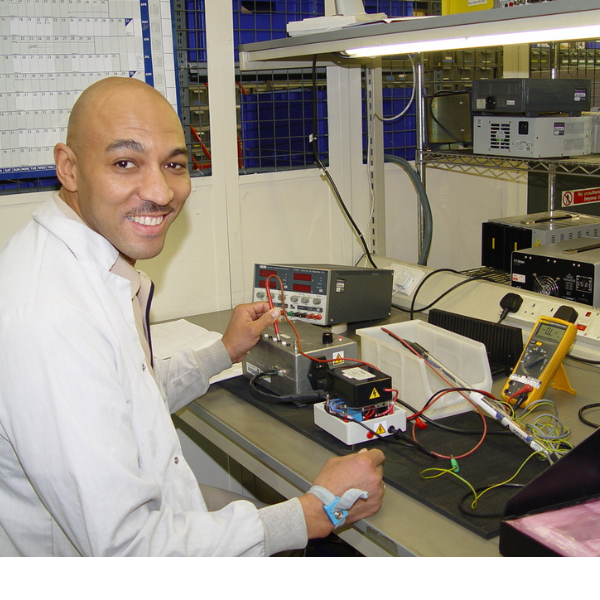
Ask Willard to describe what he does, and the answer comes back immediately and without the slightest attempt at embellishment: “My job is to find the faults.”
Ask him whether he is genuinely good at it and his face does something rather wonderful. It lights up. He smiles in the way that people smile when they are talking about something they actually love, not something they have learned to love because they have been doing it for a long time but something that still catches them, still engages them, still gives them a little spark when they think about it properly.
The way he describes fault finding is the way a good detective might describe their craft. You observe. You form a theory. You follow the sequence. You test each step against the evidence. And when the answer arrives and it arrives exactly where you predicted it would, in precisely the order you laid out, the feeling is unlike anything else. “Sometimes you feel like you are never going to solve it,” he admits, leaning forward slightly. “But when you do, and it lands exactly as you predicted, it’s really satisfying.” The satisfaction, he makes clear, never really gets old.
What strikes me as particularly interesting is his answer when I ask about how much the field has changed over his nearly four decades in it. Many people in technical roles will tell you that the pace of change has been relentless, that the job today bears almost no resemblance to the job they started. Willard’s answer is different. The fundamentals of testing, he says, have remained remarkably consistent. Components evolve. The products Texcel works on have become far more diverse as the company’s customer base has grown and spread across different sectors. But the logic of fault finding, the rigour of the method, the disciplined thinking that sits at the heart of good testing, has not changed in any meaningful way. In a world that has been in permanent technological upheaval since 1987, there is something quietly remarkable about that.
Warm, Reliable, Knowledgeable.
The people who work with Willard reach, fairly consistently, for the same words: knowledgeable, reliable, warm, kind. When I put those words to him directly he sits with it for a second, in the way that people do when they are hearing something that lands and then say "I guess we see ourselves through other people."
It is a small moment but it says a great deal. There is a particular kind of person who understands that we do not discover who we are in isolation, that it is in the reflection we find in the people around us, in the trust they place in us and the way they reach for us when they need help, that we come to understand ourselves most clearly. Willard is that kind of person. He has spent nearly 39 years building something in the people around him, a sense that they are capable, that they are supported, that someone in the room knows what they are doing and is not going anywhere. And in their words back to him, warm, kind, reliable, he can finally see what he has built. There is no ego here but there is, if you look carefully, a quiet and well-earned pride.
What he is most proud of, after nearly four decades, is not a technical achievement. It is not a particularly difficult fault he found, or a project that went especially well, or a process he improved. It is the trust he has built with the people in this company. He says this plainly and without any sense that he expects it to be a surprising answer. To him it is entirely obvious. The trust you build with colleagues, the reputation you carry in the relationships you have at work, that is the thing that matters. That, he says, is a very important thing.
A Company That Finds a Place for Everyone 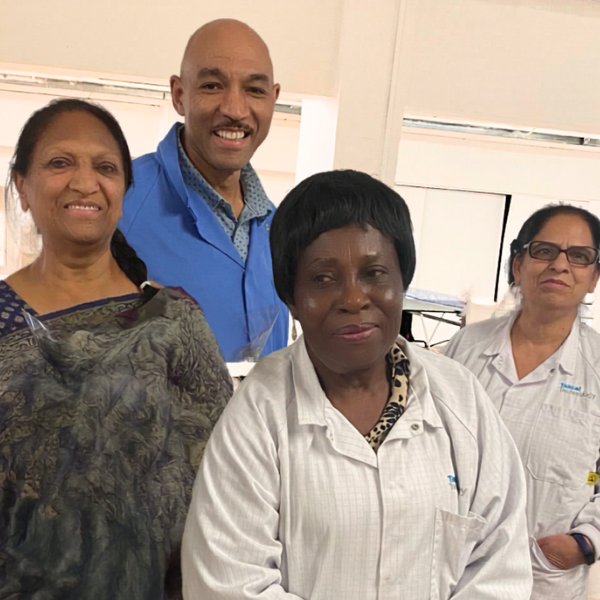
39 years gives you a perspective on a company that no management report or strategy document can replicate. I ask Willard how Texcel has changed over that time, and his answer is thoughtful and measured, as you would expect from a man who has spent his career not jumping to conclusions before the evidence is in.
In some ways, he says, it has remained quite similar to the company he joined. “People come and go. Some are more dedicated, some are less.” The products have become more diverse, the customer base has grown and spread across different sectors, the scale of the operation has changed. But the cultural heart of the place, the can-do attitude that was there in that industrial shed in Greenwich in 1987, has stayed intact. That is not nothing. Plenty of companies lose their culture as they grow. Texcel, in his experience, has held onto it.
What Texcel does particularly well, he believes, is look after its people. The way he puts it is striking in its generosity: “Take people on and accept them.” There is, he says, a genuine way of finding a place for everyone to fit, of seeing potential rather than limitations and of building something around what people can do rather than writing them off for what they cannot.
Would he recommend Texcel to a young engineer just starting out in the industry? The answer comes without any hesitation. Yes, entirely. The variety of products, the flexibility of the working environment and the sheer volume of experience on offer make it, in his view, an outstanding place to begin a career in electronics. “You get so much here,” he says. “You are exposed to so much variety. It’s a great place to start.”
“Always have faith in people. Don’t be too rigid and go with the flow.”
Passing On What Cannot Be Written in a Manual
One of the harder questions that arises whenever someone with Willard’s depth of experience prepares to leave is what happens to the knowledge they carry. Some of it can be documented: processes, procedures, technical specifications. But a great deal of what makes someone like Willard invaluable lives in the accumulated instinct of nearly four decades of daily practice, in knowing which symptom points to which fault, in recognising a pattern you have seen a hundred times before even when it presents itself slightly differently. That kind of knowledge does not transfer easily to a manual.
Willard has thought carefully about this. His approach to the problem is characteristically generous. Rather than simply doing jobs himself, which would be the faster and easier option for almost anyone with his level of experience, he stops and uses every opportunity as a teaching moment. “Where a job might be easy for me to just go and do myself,” he says, “I stop and help them learn it.” He gives people the knowledge because he believes that is the right thing to do, not because he has been asked to or because it sits in his job description.
He has clearly thought, too, about what the most important things are to pass on, beyond the purely technical. When I ask him what advice he would give to someone just starting out on the technical ladder, his answer is both simple and surprisingly deep. Always have faith in people. Don’t be too rigid. Go with the flow. It is the advice of someone who has seen, over many years, that the technical skills can be learned but the quality of the relationships you build, and the flexibility of how you move through a working life, matter just as much.
Harvey and Health 
Away from the test bench, Willard takes his health seriously. The gym features regularly, as does cardio and he talks about keeping fit with the perspective of someone who has come to appreciate it more as the years have passed. “As a younger person you take it for granted,” he says. “Now I want to be healthy and strong.” It is, like most things he says, entirely straightforward and entirely sincere.
When the conversation turns to films, Willard does not hesitate. His choice is Harvey, the 1950 James Stewart classic in which a man named Elwood P. Dowd moves through life with his closest companion: an invisible six-foot rabbit that nobody else can see. It is a film that the world largely misses the point of, dismissing Elwood as eccentric or deluded, while the audience gradually realises that he is, in fact, the sanest and most contented person in it. The film is about acceptance, about the human spirit, about choosing kindness over the exhausting business of conformity. It is about finding worth in people that others might be too busy or too conventional to notice.
It is, when you sit with it for a moment, an almost uncannily perfect choice. Because if you were to write down the values that Willard Fennell has quietly carried through nearly 39 years at Texcel, you would end up with something very close to Elwood's. Faith in people. Warmth without agenda. A complete absence of ego. The belief that how you treat others is not a soft concern sitting alongside the real work but is, in fact, the real work. He did not choose Harvey to make a point about himself. He chose it because he loves it. But the fit is so exact it is hard not to smile.
I’m Going to Wake Up and Punch the Air
Retirement, for Willard Fennell, does not appear to carry a single gram of anxiety. He is looking forward to it with the uncomplicated enthusiasm of a man who has earned it completely, knows it and is not going to pretend otherwise.
Colleagues have been expressing their sadness at his leaving, knowing something important is ending. He finds this genuinely moving. He is enormously grateful for it. But he is also very clear, with an honesty that feels entirely characteristic, that he does not take his situation for granted. He knows that being able to retire, emotionally settled and financially prepared, with a partner and plans and a sense of what comes next, is not a position everyone reaches. Some people do not get to choose. Some people do not get to plan. He thinks about that. “People at work have been expressing their sadness,” he says, “but I am deeply appreciative of my position. I am lucky and fortunate to be in this situation. I don’t take it for granted.”
What’s the first thing you’re going to do on that first Monday morning when you don’t have to be anywhere, I asked him, and then, breaking into the biggest smile of the afternoon: “I’m going to wake up and punch the air and think, I’ve made it!”
What comes after the punching of the air? His wife, he reports with evident amusement, has a long list of jobs for the house and he would quite like to stop waking up at five in the morning, beyond that, he is happy to play it entirely by ear. After nearly 39 years of methodical, patient, precise and careful work, of following the sequence and trusting the process, perhaps the greatest luxury available to him now is the freedom to have no sequence at all.
He has earned that. Every single day of it.
We wish him the all the best in his next chapter.